Can You Negotiate Severance Without Hiring a Lawyer
If you were laid off and do not want to hire a lawyer read this first
After a termination meeting, most employees face two immediate questions:
Should I sign this severance offer?
Do I need to hire a lawyer?
Legal advice can be expensive. For many job seekers, especially after sudden income loss, paying for a consultation feels overwhelming. At the same time, signing too quickly can permanently close the door on additional compensation.
The reality is that many employees can begin negotiating severance without immediately hiring a lawyer. The key is understanding where the risk lies, where the leverage sits, and how to structure your response properly.
When negotiating without a lawyer may make sense
There are situations where informal negotiation can be reasonable. For example:
The gap between the offer and minimum statutory entitlements appears modest
Your employment contract clearly limits you to the minimum standards
You have short service and a junior role
The employer is open to discussion and acting professionally
Employment standards legislation sets baseline protections. For federally regulated workers, the Canada Labour Code outlines minimum notice and severance requirements. For most other employees, provincial laws apply. The Ontario Ministry of Labour explains termination and severance obligations under the Employment Standards Act.
If your offer clearly exceeds these minimum standards and your contract is enforceable, negotiation may be limited in scope. In that case, a structured and professional response may be enough to secure modest improvements.
When negotiating alone becomes risky
There are also situations where negotiating without legal insight carries meaningful risk. You may want legal advice if:
You have long service
You are over 45
You held a managerial or specialized role
Your contract contains a complex termination clause
You were recruited or induced from another employer
The difference between minimum standards and potential common law notice appears large
The Supreme Court of Canada confirmed in Machtinger v HOJ Industries Ltd that employment standards legislation creates minimum protections that cannot be contracted out of. Courts frequently invalidate termination clauses that conflict with statutory standards.
If your clause is unenforceable, your entitlement may shift from minimum standards to common law reasonable notice. That difference can represent months of compensation.
Negotiating without understanding that distinction can result in under settling.
What you need to understand before negotiating on your own
If you plan to negotiate without immediately hiring a lawyer, you need clarity on five things.
The difference between statutory minimums and common law notice.
Whether your termination clause is likely enforceable
What components of compensation are included in the offer.
Your leverage factors such as age, tenure, and role.
How to communicate professionally and strategically.
Statistics Canada data shows that reemployment timelines vary significantly by age and occupation. Courts consider these realities when assessing reasonable notice. That context matters in negotiation.
If you do not understand these fundamentals, you are negotiating blind.
How to structure a severance negotiation without a lawyer
If you choose to begin the process yourself, follow a disciplined structure. Start by responding in writing. Thank the employer for the offer. Confirm you are reviewing it carefully. Next, request clarification on what portion reflects statutory minimum entitlements and what portion is discretionary.
Then, anchor your request in objective factors. For example:
Based on my length of service and role, I believe the offer may not fully reflect my common law entitlements. I would like to discuss an adjustment.
Avoid emotional language. Avoid threats. Avoid ultimatums. Severance negotiation is a business discussion. Treat it like one.
Common mistakes employees make when negotiating alone
Negotiating without preparation often leads to preventable errors. Common mistakes include:
Accepting the first offer out of fear
Threatening legal action too early
Focusing only on base salary
Ignoring bonuses and benefits
Not reviewing restrictive covenant language
Misunderstanding the impact of signing a release
Once a release is signed, reversing it is difficult. Courts set a high threshold for undoing signed agreements.
The safest approach is informed negotiation, not rushed negotiation.
Why many employees do not actually need full legal representation
Here is the important nuance. Not every severance situation requires litigation. Not every negotiation requires a retained lawyer from the outset.
Many employees simply need:
A clear framework to evaluate their offer
A structured way to calculate potential leverage
Professionally written response language
Guidance on how to handle deadlines
A step by step negotiation roadmap
That is different from hiring a lawyer to run the file. In many cases, structured preparation significantly improves outcomes without immediate legal fees.
The real question is not lawyer or no lawyer
The real question is whether you are negotiating with clarity. You can negotiate without hiring a lawyer immediately. But you cannot negotiate effectively without understanding:
The gap between minimum standards and potential common law notice
The enforceability of your termination clause
The full value of your compensation package
How to communicate strategically
If you lack that clarity, you are at a disadvantage.
If you have that clarity, you are negotiating from strength.
Before you decide how to proceed
Ask yourself:
Do I understand what I am legally entitled to?
Have I separated statutory minimums from enhanced amounts?
Have I reviewed my contract carefully?
Do I know what my leverage factors are?
Am I responding strategically rather than emotionally?
If the answer to any of these is no, your first step is preparation. For employees who want to negotiate confidently without immediately retaining a lawyer, a structured severance response pack can provide the exact scripts, leverage framing, and negotiation roadmap needed to respond professionally and strategically.
It bridges the gap between uncertainty and over spending on legal fees, while keeping escalation options open if needed.
Preparation is leverage. Clarity is protection.
Can you negotiate severance without a lawyer and still protect yourself
Yes, you can negotiate severance without hiring a lawyer. But you should never negotiate without understanding your rights.
The real risk is not negotiating alone. The real risk is negotiating without clarity about the gap between minimum standards and common law notice, without reviewing your termination clause, and without structuring your response strategically.
You do not need to panic hire legal representation the moment you receive an offer. Many employees successfully improve their severance packages through informed, professional negotiation. What you do need is preparation, clear language, and a framework that keeps you from making emotional or rushed decisions.
If you want to negotiate confidently without immediately retaining counsel, structured guidance makes the difference. A well designed severance response pack gives you the scripts, leverage positioning, and step by step roadmap to respond professionally, request adjustments strategically, and preserve your legal options if escalation becomes necessary.
Severance is not just paperwork. It is your financial bridge to what comes next. Approach it with preparation, not pressure.
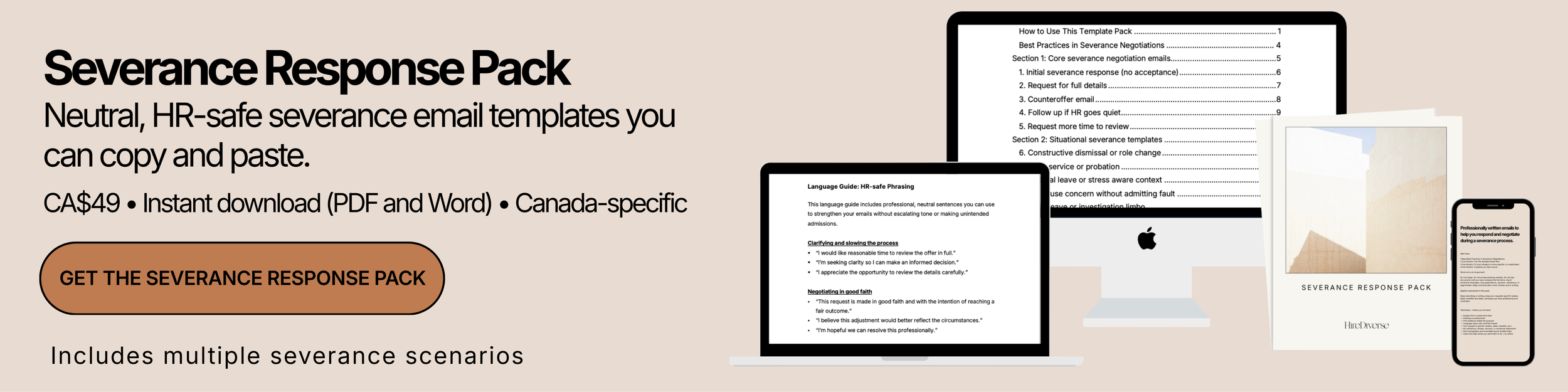
Severance Response Pack
Structured severance response and negotiation email drafts, written in a neutral, HR-safe tone.
CA$49 • Instant download • Canada-specific

Frequently asked questions about negotiating severance without a lawyer
Is it legal to negotiate severance on my own in Canada?
Yes. Employees can negotiate severance offers directly with employers. You are not required to retain a lawyer to have a discussion.
Will my employer withdraw the offer if I try to negotiate?
Employers rarely withdraw minimum statutory entitlements. Enhanced offers may be time limited, but professional negotiation often leads to discussion rather than withdrawal.
How do I know if my offer reflects common law notice?
You need to compare the offer against your tenure, age, role, and contract terms. If the offer mirrors only minimum statutory standards, it may not reflect full entitlement.
Should I still consult a lawyer eventually?
If the financial gap appears significant or your contract is complex, obtaining legal advice can be valuable. Many employees negotiate informally first, then consult if needed.
What is the safest way to negotiate without a lawyer?
Prepare thoroughly, respond in writing, anchor your request in objective legal factors, avoid emotional framing, and do not sign a release until you fully understand your entitlement.