What Happens If You Try to Negotiate Your Severance in Canada
If you’re nervous to negotiate your severance you’re not alone
One of the most common fears after being laid off in Canada is this:
What happens if I try to negotiate?
Will they withdraw the offer?
Will I make things worse?
Will I look difficult?
That fear keeps many employees from even asking questions.
In reality, severance negotiation is far more common and far less dramatic than most people imagine. Understanding what actually happens when you push back, and what does not happen, can remove a great deal of uncertainty.
First understand what severance really is
Severance in Canada is not a gift. It is a legal framework.
Employment standards legislation sets minimum protections. For federally regulated employees, the Canada Labour Code outlines minimum notice and severance obligations. Most other employees fall under provincial laws. For example, the Ontario Ministry of Labour explains termination pay and severance pay requirements under the Employment Standards Act.
These are minimum floors.
Unless you have a valid and enforceable termination clause limiting your entitlement, you may also be entitled to common law reasonable notice. The Supreme Court of Canada confirmed in Machtinger v HOJ Industries Ltd that employment standards legislation establishes minimum protections that cannot be contracted out of.
This means that in many cases, there is room for discussion beyond the statutory baseline. Negotiation is not inappropriate. It is part of the system.
What actually happens when you negotiate
In most cases, one of the following happens.
The employer increases the offer modestly.
The employer adjusts structure instead of the total amount.
The employer extends benefit continuation.
The employer clarifies bonus treatment.
The employer holds firm.
What rarely happens is the dramatic withdrawal of all compensation. Your minimum statutory entitlements cannot disappear because you asked a question. Those rights are protected by law.
In many organizations, severance offers are intentionally positioned with some room for movement. Employers often expect at least limited discussion.
Why employees hesitate to negotiate
There are understandable reasons people hold back.
You may worry about damaging your reputation.
You may feel grateful for any payment.
You may fear conflict.
You may be overwhelmed and want closure.
Statistics Canada consistently reports that job loss creates significant financial stress for households. When income stops suddenly, emotional decision-making increases.
But severance negotiation is not about confrontation. It is about clarification and alignment with legal norms.
The risk of not negotiating
The greater risk is often silence.
If your offer reflects only minimum statutory standards and your termination clause is unenforceable, you may be entitled to significantly more under common law notice.
Common law reasonable notice considers:
Length of service
Age
Position and seniority
Availability of comparable employment
These factors can materially increase compensation beyond minimum standards.
If you sign a release without reviewing whether the offer reflects common law exposure, that opportunity is usually gone.
How employers typically view negotiation
From an employer perspective, negotiation is a business discussion. Human resources teams and counsel understand that employees may seek advice and ask for adjustments. A respectful and fact based request does not automatically signal hostility.
In fact, many employers prefer structured negotiation over immediate legal escalation. Approaching the conversation calmly often preserves relationships while still protecting your interests.
How to negotiate without escalating unnecessarily
If you choose to negotiate, structure matters.
Thank the employer for the offer.
Confirm you are reviewing it.
Reference objective factors such as tenure and role.
Request a discussion rather than making demands.
For example:
Based on my length of service and responsibilities, I would like to discuss whether the offer can be adjusted to better reflect my circumstances.
This tone is professional. It signals seriousness without aggression.
What if the employer says the offer is final
Sometimes the employer will say the offer is firm. Even then, you still benefit from understanding whether the offer aligns with your entitlement. If the gap is small, you may choose to accept. If the gap is substantial, escalation through legal counsel may become a strategic decision.
The key is informed choice, not assumption.
Deadlines and pressure
Short deadlines are common. A deadline does not eliminate your statutory minimum rights. It also does not automatically mean the offer disappears the moment the clock runs out. In practice, many deadlines are flexible when approached professionally.
The safest approach is to request reasonable time to review and consider your options.
When negotiation makes the most difference
Negotiation tends to have the greatest impact when:
You have long service
You are over 45
You held a managerial or specialized role
The termination clause is questionable
You were recruited from secure employment
In these cases, the gap between minimum standards and potential common law notice may be meaningful.
Before you decide whether to negotiate
Ask yourself:
Do I understand the difference between statutory minimums and common law notice.
Have I reviewed my employment contract carefully.
Does the offer clearly separate minimum and enhanced amounts.
Do I know my leverage factors?
Am I reacting emotionally or strategically.
Negotiation should be grounded in clarity, not fear.
Negotiating your severance is not reckless it is responsible
Trying to negotiate your severance in Canada is not confrontational. It is not ungrateful. It is not inappropriate. It is a normal part of a legal and financial process that already assumes power imbalance.
Employment standards legislation sets minimum protections. Common law reasonable notice may extend those protections significantly depending on your circumstances. When you understand that distinction, negotiation becomes less about conflict and more about alignment.
The real risk is not asking. The real risk is signing a release without understanding whether the offer reflects your full entitlement.
You do not have to escalate immediately. You do not have to threaten litigation. You do not have to approach the conversation emotionally. But you do have the right to pause, review, and respond strategically.
Severance is your financial bridge to what comes next. Protecting it is not aggressive. It is prudent.
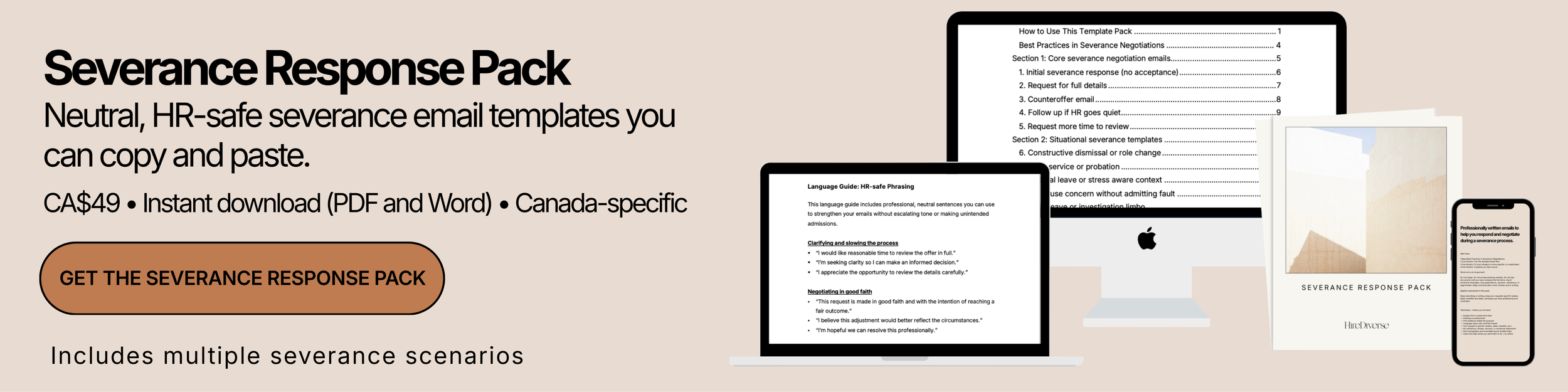
Severance Response Pack
Structured severance response and negotiation email drafts, written in a neutral, HR-safe tone.
CA$49 • Instant download • Canada-specific

Frequently asked questions about if you can negotiate a severance offer in Canada
Can my employer withdraw my severance if I try to negotiate?
Your minimum statutory entitlements cannot be withdrawn because you asked questions. Enhanced amounts may be discussed, but professional negotiation rarely results in total withdrawal.
Will negotiating make me look difficult?
When approached respectfully and fact based, negotiation is generally viewed as a normal business discussion rather than hostility.
How much more can I realistically get?
It depends on your length of service, age, role, and contract terms. In some cases, the difference between minimum standards and common law notice can be substantial.
What if my employer says the offer is final?
You can assess whether the offer aligns with your potential entitlement. If the gap is significant, seeking legal advice may be appropriate.
Should I negotiate before hiring a lawyer?
Many employees begin discussions informally. If the financial gap appears large or the contract is complex, legal advice can help clarify strategy.
Negotiation is not a gamble. It is a structured conversation within a legal framework. The most important step is understanding that asking is not reckless. Signing without understanding can be.