What Termination Without Cause Really Means for Your Severance in Canada
What you need to understand after being terminated without cause in Canada
Being terminated without cause can feel abrupt and confusing. You’re told your role is ending, handed paperwork, and often given a short deadline to sign. The message may sound neutral or even sympathetic. But there are important details that are rarely explained clearly in that moment.
In Canada, termination without cause triggers legal obligations that go beyond minimum standards. What employers do not always spell out is that your severance may be negotiable, that statutory minimums are not the full picture, and that signing quickly can permanently limit your rights.
Understanding what is not said is just as important as reading what is written.
Minimum standards are not your full entitlement
When you are terminated without cause, your employer must comply with provincial or federal employment standards legislation. That includes minimum notice or pay in lieu of notice, and in some cases, statutory severance pay.
What is often not emphasized is that these are minimum legal floors. Common law reasonable notice frequently exceeds those amounts.
Courts assess reasonable notice based on factors such as:
Your age
Your length of service
Your position
The availability of comparable employment
If your offer reflects only minimum standards, it may not reflect what you could receive under common law.
Your employer may not explain common law notice
Most termination letters reference employment standards legislation. They rarely explain common law reasonable notice in detail.
Common law can result in significantly longer notice periods than statutory minimums. For long service employees, managers, executives, or specialized professionals, notice periods can extend well beyond a few weeks per year of service.
Employers are not required to educate you about the full scope of common law entitlement in a termination meeting. That responsibility falls to you.
Short deadlines create pressure
It is common to receive a deadline of 48 hours or less to sign a severance agreement. The urgency can create the impression that delay will cause the offer to disappear.
In practice, many employers will extend deadlines if asked professionally. The initial short timeline is often designed to encourage quick resolution.
What is not always stated clearly is that once you sign a release, you typically waive your right to pursue additional compensation related to your termination. The pressure to sign quickly can work against your long-term financial interests.
Termination clauses are not always enforceable
If your employment contract includes a termination clause limiting severance to minimum standards, your employer may rely on it when calculating your package.
However, Canadian courts have repeatedly struck down termination clauses that do not strictly comply with employment legislation. When a clause is invalid, common law reasonable notice applies instead.
This can dramatically increase your entitlement. Your employer may present the contract limitation as definitive. It may not be.
Bonuses and incentives are often minimized
Many severance packages focus on base salary. Variable compensation, such as bonuses, commissions, or long-term incentives, may be excluded or calculated narrowly.
Under common law principles, total compensation is often considered when determining damages for wrongful dismissal. That can include expected bonuses during the reasonable notice period.
If a large portion of your income came from variable pay, its exclusion could significantly undervalue your package.
Benefits continuation is part of the equation
Health coverage, disability insurance, pension contributions, and other benefits can represent substantial value.
A termination letter may outline benefits continuation only for the statutory minimum period. If your reasonable notice period under common law is longer, the value of those benefits during that extended period may need to be accounted for.
Severance is more than a lump sum. It is a bridge that should reflect your full compensation structure.
Without cause does not mean without rights
Termination without cause does not imply misconduct or performance failure. It simply means the employer has chosen to end the employment relationship for business reasons.
Because there is no allegation of misconduct, you are entitled to notice or pay in lieu of notice. That entitlement is where negotiation often arises.
Many employees internalize termination as personal failure and accept the first offer out of discomfort. The legal framework, however, is objective and financial.
This is not about fault. It is about notice.
Why negotiation is common in without cause terminations
Employers often approach termination packages as risk management exercises. They estimate potential exposure and make an offer that they believe may resolve the matter efficiently.
Employees who understand common law principles may respond with a counterproposal based on objective factors. This is not unusual in Canada.
A respectful and structured negotiation can lead to improved compensation without escalating conflict.
Protecting yourself after termination
If you have been terminated without cause, consider these steps before signing:
Review your length of service and age
Assess the level and specialization of your role
Examine whether your contract termination clause is compliant
Calculate total compensation, including bonuses
Consider current hiring conditions in your industry
Evaluate the timeline provided for signing
Taking time to assess these factors allows you to move from reacting emotionally to responding strategically.
Your financial runway depends on informed decisions
Severance is designed to provide financial support during the time it should reasonably take to secure comparable employment.
Accepting less than your potential entitlement can shorten that runway and increase stress during transition. Understanding what is not explained in the termination meeting gives you leverage.
Termination without cause may feel sudden. Your response does not have to be.
Pause. Review. Assess. Then decide.
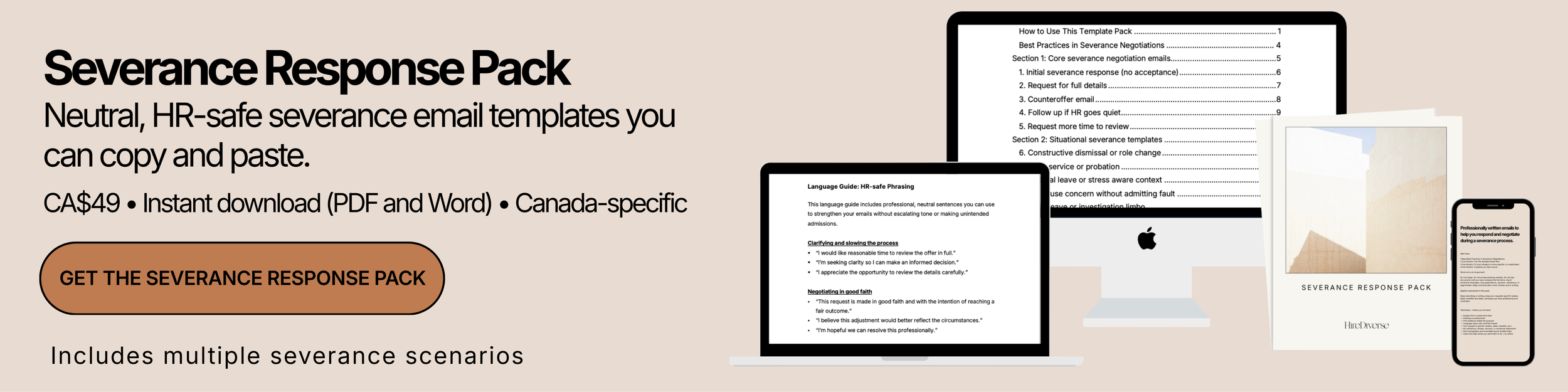
Severance Response Pack
Structured severance response and negotiation email drafts, written in a neutral, HR-safe tone.
CA$49 • Instant download • Canada-specific

Frequently asked questions about termination with cause and severance in Canada
What does terminated without cause mean in Canada?
It means your employer ended your employment for business reasons rather than misconduct. You are entitled to notice or pay in lieu of notice.
Is severance guaranteed if I am terminated without cause?
Yes. Employers must provide at least minimum notice or pay in lieu under employment standards legislation. You may also be entitled to more under common law.
Can I negotiate my severance after being terminated without cause?
Yes. Negotiation is common in Canada. If the offer does not reflect common law reasonable notice, you may have grounds to request more.
What if my contract limits me to minimum severance?
Some termination clauses are invalid if they do not comply with legislation. If a clause is unenforceable, common law reasonable notice may apply instead.
Does without cause termination affect my future employment?
No. Without cause termination does not imply wrongdoing. It is generally viewed as a business decision rather than misconduct.