How Much Severance Should You Really Get in Canada
How severance pay and benefits are really determined in Canada
When you’re let go without cause, one of the first questions that hits you is simple but loaded: How much severance should I actually receive?
Most employees assume the number in their termination letter must be correct. It looks official. It references legislation. It may even say the package is “generous.” But in Canada, there’s a major difference between minimum severance and full legal entitlement. And that gap is where many people leave money on the table.
Understanding what you should really receive is the first step toward protecting your financial stability during a job transition.
The difference between minimum standards and common law notice
In Canada, severance is governed by two layers of law.
The first layer is provincial or federal employment standards legislation. These laws set minimum termination pay and, in some provinces, statutory severance pay. These are legal floors. Employers cannot go below them.
The second layer is common law reasonable notice. This is where the numbers often increase significantly.
Common law does not use a fixed formula. Instead, courts look at several factors, including:
Your age
Your length of service
Your position and level of responsibility
The availability of comparable employment
For many employees, common law entitlement can be several times higher than the statutory minimum. If your employer only offered the minimum required by legislation, you may be entitled to more.
There is no simple “one week per year” rule
You may have heard that severance equals one week per year of service. That rule applies only to certain statutory minimums. It does not reflect common law notice.
In practice, courts often award notice periods that are far more generous. For long-service or senior employees, it is not unusual for notice periods to exceed one month per year of service. In some cases, they can be even higher depending on the circumstances.
Relying on a simplified formula can lead to underestimating your entitlement.
Your age matters more than you think
Age plays a significant role in determining reasonable notice. Courts recognize that older employees may face longer job searches and greater barriers to comparable employment.
If you are over 40, 50, or nearing retirement, your notice period may be longer than that of a younger employee with similar tenure. Ignoring age in the severance calculation is a common way packages are undervalued.
Your role and income level affect your entitlement
Executives, managers, and specialized professionals often receive longer notice periods than entry-level employees. That’s because comparable roles are fewer and competition can be stronger.
If your position involved significant responsibility, leadership, or niche expertise, your severance should reflect the time it may realistically take to secure a similar opportunity.
Compensation structure also matters. If a portion of your income came from bonuses, commissions, or incentives, those amounts may need to be included in the notice period calculation.
Employment contracts can change the outcome
Some employment contracts attempt to limit severance to statutory minimums. However, many termination clauses are drafted improperly and have been struck down by Canadian courts.
If a termination clause is invalid, you may automatically fall back to common law reasonable notice, which can dramatically increase the value of your package.
Never assume a contract clause is enforceable without careful review.
Job market conditions influence reasonable notice
Severance is meant to compensate you for the time it should reasonably take to find comparable employment.
If your industry is contracting, hiring is slow, or roles similar to yours are limited, your reasonable notice period may be longer. Courts consider real-world job market conditions, not theoretical timelines.
An offer that assumes you will find a comparable role in a few weeks may not reflect reality.
How to estimate what you should really receive
There is no universal calculator that produces a guaranteed number. However, you can assess your situation using these questions:
How many years did you work for the employer
How old are you
What level was your position
How specialized was your role
How strong is the hiring market in your field
The answers to these questions often reveal whether your severance package is aligned with common law principles or simply minimum compliance.
If your offer feels low based on these factors, it may be time to consider negotiating.
Why most people underestimate their entitlement
There are three common reasons employees accept less than they could receive.
First, they assume employers have calculated everything correctly. In reality, employers often calculate based on risk management and cost control.
Second, they feel pressured by short deadlines.
Third, they fear that negotiating will damage their reputation.
In Canada, negotiation is common in termination situations. A professional and informed response is not viewed as misconduct. It is viewed as part of the process.
Severance is about more than a number
Severance affects your runway. It impacts how long you can search for a comparable role without financial panic. It influences whether you can retrain, relocate, or wait for the right opportunity instead of accepting the first one available.
Accepting too little can compress your transition and increase stress during an already difficult time.
Understanding how much you should really receive is not about being aggressive. It is about ensuring your financial bridge reflects your real circumstances.
If you suspect your package does not align with common law principles, you may have room to negotiate
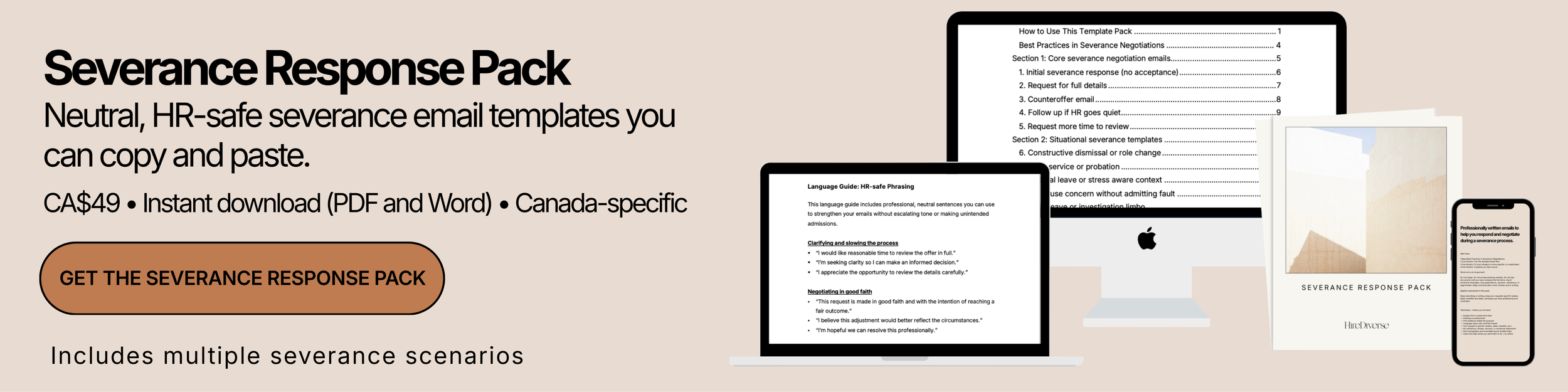
Severance Response Pack
Structured severance response and negotiation email drafts, written in a neutral, HR-safe tone.
CA$49 • Instant download • Canada-specific

Frequently asked questions about how much severance you should really get
How much severance should I get per year of service?
There is no universal formula. Statutory minimums may provide one week per year in some provinces, but common law notice can be significantly higher depending on age, role, and job market conditions.
Is two weeks per year of service fair?
It depends on your circumstances. For some employees, two weeks per year may still fall below common law entitlement. Fairness is determined by reasonable notice factors, not a flat multiplier.
Does age really increase severance?
Yes. Courts recognize that older employees may face longer job searches. Age is one of the core factors used to determine reasonable notice.
Can I negotiate if the offer is above minimum standards?
Yes. Even if an offer exceeds statutory minimums, it may still fall below common law entitlement. Negotiation is common in Canadian termination situations.
What happens if I sign and later realize it was too low?
Once you sign a release, you typically waive your right to pursue additional compensation. That is why reviewing your entitlement before signing is critical.