What a 48 Hour Severance Deadline Really Means
Understanding your rights when it comes to your severance response deadline
You’re called into a meeting. Your role has been eliminated. A severance package is placed in front of you. Then you hear it. You have 48 hours to sign.
In that moment, the clock feels louder than the conversation. You are processing shock, financial uncertainty, and legal language all at once. The deadline can make it seem like you have only one real option. Sign quickly or lose the offer.
But in Canada, a 48 hour severance deadline is rarely as fixed or as final as it sounds. Understanding what it actually means and how it functions within Canadian employment law can significantly change how you respond.
Why employers use 48 hour deadlines
Short deadlines are designed to create urgency. When time feels limited, people are more likely to accept what is in front of them rather than question it.
From an employer’s perspective, the goal is closure. From an employee’s perspective, it often feels like pressure. It is important to understand that the deadline typically applies only to the enhanced portion of the offer. Your minimum entitlements under employment standards legislation cannot be taken away simply because you did not sign within 48 hours.
The Government of Canada outlines minimum notice and severance standards under the Canada Labour Code for federally regulated workers, and similar protections exist under provincial laws.
The deadline is a negotiation tool. It is not a countdown to losing your legal rights.
Minimum entitlements versus common law notice
One of the most misunderstood aspects of severance in Canada is the difference between minimum statutory entitlements and common law reasonable notice.
Statutory minimums are set by provincial or federal legislation. For example, the Ontario Ministry of Labour explains that the Employment Standards Act establishes minimum termination pay and severance pay where applicable.
However, unless you have a valid and enforceable employment contract limiting your entitlement, you may be owed significantly more under common law reasonable notice. Canadian courts have consistently reinforced this principle, including in Machtinger v HOJ Industries Ltd where the Supreme Court of Canada confirmed that employment standards legislation creates minimum floors, not maximum limits.
A 48 hour deadline does not override these principles. It simply attempts to accelerate your decision.
Why 48 hours is rarely enough time
Termination is not just a legal event. It is a financial and emotional one. Statistics Canada reports that job loss is one of the most significant sources of financial stress for Canadian households. When you are absorbing income disruption, benefit loss, and potential career shifts, expecting full legal analysis within 48 hours is unrealistic for many people.
Courts consider whether an employee had a meaningful opportunity to seek independent legal advice before signing a release. While there is no automatic rule that 48 hours is invalid, context matters. Length of service, seniority, vulnerability, and clarity of the offer all play a role. If you are being rushed, that pressure is relevant.
What happens if you don’t sign within 48 hours
In most cases, one of three things happens.
The employer extends the deadline.
The employer keeps the original offer open informally.
The employer reverts to minimum statutory entitlements.
What does not happen is the disappearance of your legal rights. You cannot sign away what you are statutorily owed by missing a deadline. In many situations, simply responding professionally and requesting additional time to obtain legal advice shifts the tone of the conversation.
Employers often expect some level of negotiation, even when the initial framing feels rigid. The deadline is part of the strategy. It is not the end of the discussion.
Signs the 48 hour tactic is being used strategically
You may notice certain patterns.
The meeting is brief and tightly scripted.
You are told the offer is generous but time sensitive.
You are discouraged from discussing the package with anyone.
You are not clearly told to seek independent legal advice.
These signals suggest the employer is relying on urgency rather than clarity. A fair severance process should separate your minimum entitlements from any enhanced offer and explicitly encourage you to seek legal advice.
How to respond strategically instead of reactively
The first step is simple. Do not sign immediately. You can respond in writing that you are reviewing the offer and intend to seek legal advice. This establishes that you are engaging thoughtfully rather than rejecting the offer.
Second, clarify what portion of the offer reflects minimum statutory entitlements and what portion is discretionary. This distinction is critical in any negotiation.
Third, assess whether your employment contract contains a termination clause and whether it is likely enforceable. Many termination clauses are later found invalid by courts because they attempt to contract out of minimum standards.
Finally, evaluate the broader context. Length of service, age, role, availability of comparable employment, and the manner of termination all influence reasonable notice assessments.
A deadline does not eliminate these factors.
The psychological effect of compressed timelines
Employers understand behavioural dynamics. Short deadlines increase acceptance rates because people fear losing what is in front of them. When you are told the offer will disappear in 48 hours, your brain processes scarcity. Scarcity triggers urgency. Urgency reduces critical analysis.
Recognizing this psychological element gives you back control. The pressure is part of the tactic. Once you see it clearly, you can respond calmly. You are allowed to take time. You are allowed to ask questions. You are allowed to negotiate.
When a rushed signature can cost you
Employees who sign within 48 hours without advice often discover later that:
They were entitled to significantly more under common law.
Their termination clause may not have been enforceable.
Comparable employees received higher packages.
The release language was broader than they understood.
Once a release is signed, undoing it is difficult. Courts may set aside agreements in cases of misrepresentation or duress, but those are high thresholds. The safest strategy is informed consent, not speed.
What this means before you respond
If you are facing a severance response deadline, pause.
Review the offer carefully.
Separate emotion from analysis.
Understand the difference between minimum entitlements and potential common law notice.
Recognize that deadlines are often negotiable in practice, even if framed as firm.
Most importantly, do not let urgency override clarity. A short timeline benefits the employer more than it benefits you. Making a strategic response within those first days can materially change the outcome of your severance.
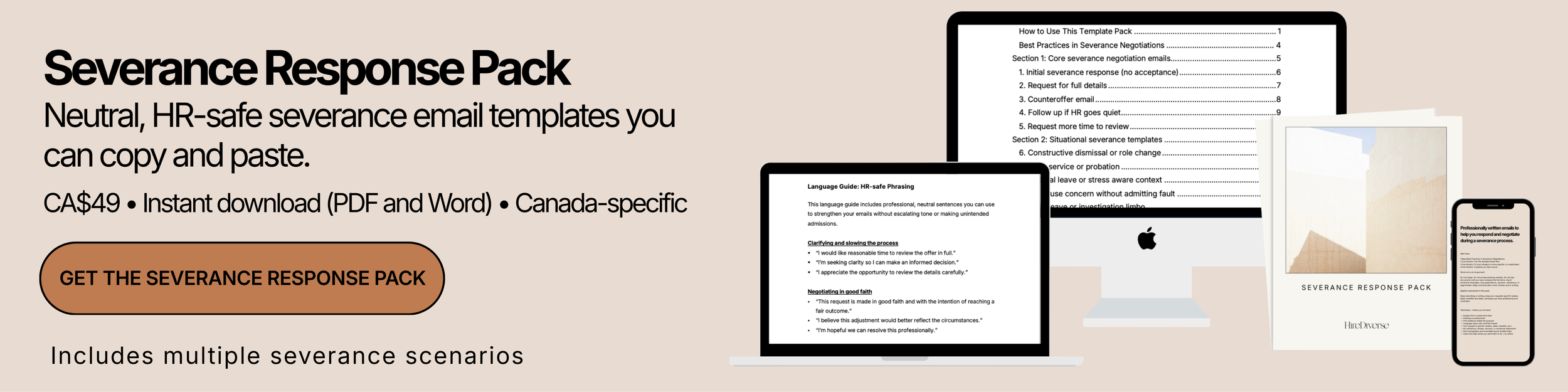
Severance Response Pack
Structured severance response and negotiation email drafts, written in a neutral, HR-safe tone.
CA$49 • Instant download • Canada-specific

Frequently asked questions about severance response deadlines
Is a 48 hour severance deadline legally binding in Canada?
The deadline itself is not illegal. However, it does not eliminate your entitlement to minimum statutory protections or potential common law notice.
Can I ask for more time to review the offer?
Yes. Many employees request additional time to seek legal advice. Employers frequently grant extensions, especially when approached professionally.
What if my employer says the offer will disappear?
In many cases, this refers only to the enhanced portion of the package. Your statutory minimum entitlements remain protected by law.
Should I ever sign within 48 hours?
Signing quickly without understanding your rights carries risk. It is generally advisable to review the offer carefully and consider obtaining independent legal advice.
How can I prepare before responding to a severance offer?
Gather your employment contract, review your length of service and role history, and clarify the difference between minimum and enhanced amounts. A structured response strategy ensures you negotiate from an informed position rather than under pressure.